Home / Levels of Care /
Agape Treatment Center’s Intensive Outpatient Program (IOP) in Fort Lauderdale
Sustainable Recovery in the Real World
Intro
Exiting a residential or day-long addiction treatment program can be a significant milestone, but it also creates additional challenges. The “bubble” of the 24/7 environment with supervisors has disappeared, and you are faced with the stresses of the real world once again. This point of transition, often referred to as the “re-entry phase”, is where recovery can be most vulnerable, as well as where recovery also becomes most real.
Agape Treatment Center has created our Intensive Outpatient Program (IOP) to be the safety net for this critical stage of recovery. Our IOP in Fort Lauderdale provides a structured yet flexible environment for you to process through the realities of early sobriety as they occur in real time.
Unlike higher levels of care that require placing life on hold, our Fort Lauderdale intensive outpatient program has been designed with real life in mind and will help you integrate into your life. You will be able to start your career, return to school, or reconnect with family while still receiving therapeutic and peer support several times per week. IOP is not just about being sober; it’s about creating a life you want to live.
What is an Intensive Outpatient Program?
An IOP is a step-down level of care that provides therapy and clinical support on a part-time basis. It serves as a transitional level of care between the full-time immersion of Partial Hospitalization (PHP) and the independence associated with standard outpatient therapy.[1]
Whereas residential or inpatient programs focus on stabilization and detoxification, IOPs focus on application, where the rubber meets the road. In IOP at Agape Treatment Center, you will learn how to cope during sessions and apply those new skills in the real world. Living the realities of early recovery allows you to bring back your experiences to be processed with your treatment team.
Key features of IOP include:
Flexible Schedule
Depending on your treatment plan, sessions are typically scheduled 3-5 days per week and offer morning or evening appointments to accommodate your work schedule.
Independence
Clients live on their own (or in a sober living environment) and manage their time independently outside of their scheduled treatment sessions.
Building Community
The program focuses on building a sober network of support outside of the facility, such as through 12-step meetings and community groups.
The Clinical Curriculum
Evidence-Based Healing
Our IOP is not only a “check-in” but rather has been developed as an in-depth, rigorous clinical program, focused on finding and treating the complex psychological root causes of addiction. The same integrative medicine philosophy used at each level of care continues to be used here as well, providing depth and continuity to your treatment.
Cognitive Behavioral Therapy (CBT)
Cognitive behavioral therapy (CBT) looks at your cognitive distortions (incorrect or negative thought patterns) that lead to your addictive behaviors.[2] We work with you in real-time through “cognitive restructuring”—if you encounter a trigger, we will look at your thought process and develop a healthy response to it.

Dialectical Behavioral Therapy (DBT)
When you are newly sober, you will have a wide variety of emotions. Dialectical behavioral therapy (DBT) teaches you how to manage these emotions and not let them control you. One of the major skills learned through DBT is distress tolerance, which is the ability to be uncomfortable emotionally and not react or turn to chemicals.[3]

Process Groups & Peer Accountability
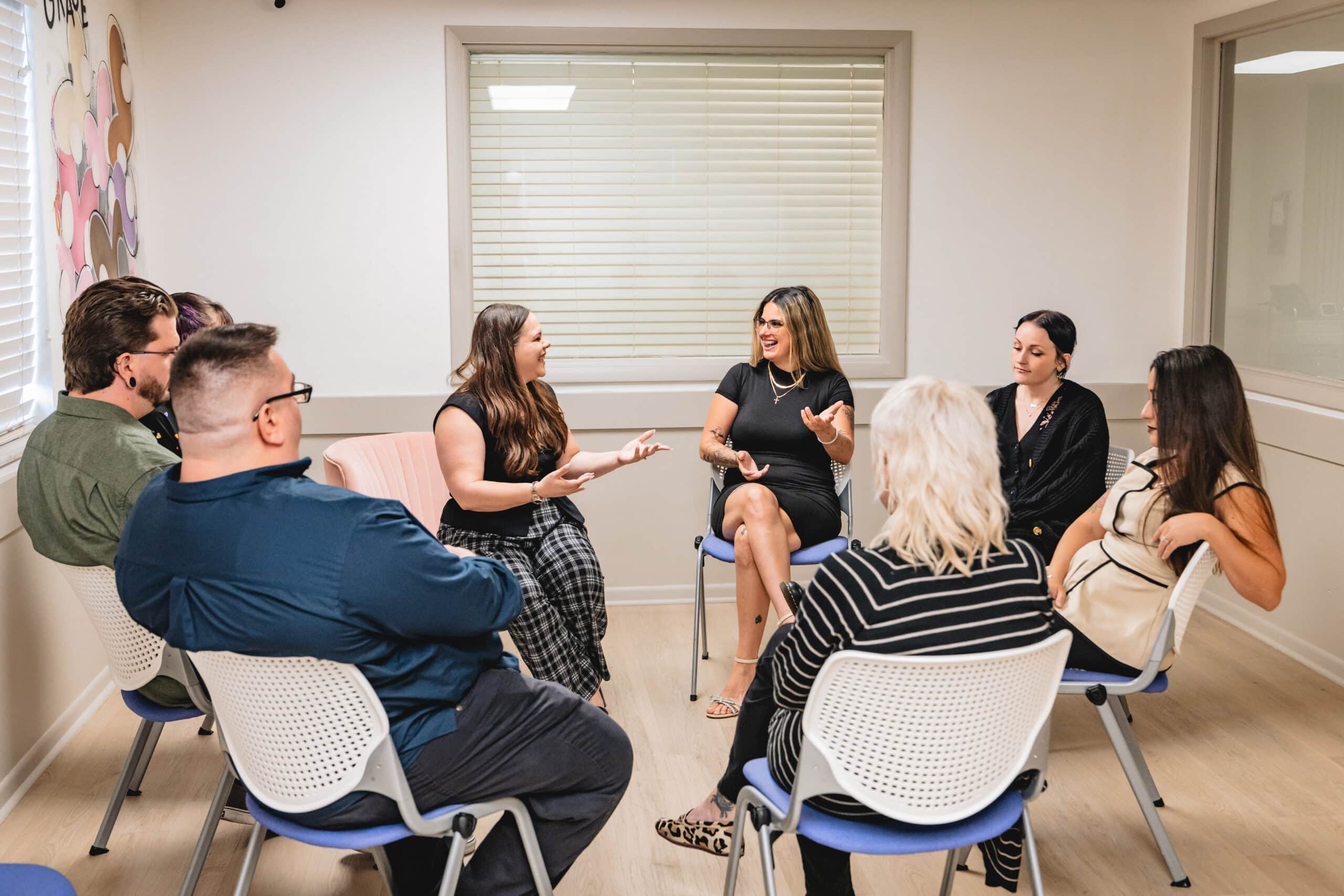
Isolation is the enemy of recovery. You will share your successes and struggles with your peers in group sessions led by a facilitator. Hearing your own story in someone else’s voice helps diminish feelings of shame and fosters a sense of belonging. The groups are kept small intentionally to ensure that every voice is heard.
Agape Wide Range of Treatment
Treating the Whole Person
Addiction does not typically come alone, as a significant percentage of our clients will have a co-occurring mental health issue such as anxiety, depression, bipolar disorder, or trauma.[4] At Agape, addressing mental health co-morbidity is part of our core mission.
You will have access to medication management and evaluation to treat your mental health condition. By treating your mental health diagnosis simultaneously with your substance abuse disorder, you will have a solid foundation for your long-term recovery.[5]
Trauma work is also part of your recovery, as a portion of those with an addiction use substances to cope with unresolved issues. Our clinicians are trauma-informed and will use different modalities within the intensive outpatient program (IOP) to help you resolve your trauma safely.
Vocational and Life Skills Development
The goal of IOP is to help you reintegrate into society. For many, this means going back to work or starting school. However, doing so in a sober state of mind can be very difficult. We offer many life skills workshops that are in addition to your therapy and provide you with practical things to do in your day-to-day life.
01
Career Counseling
Resume building, interview prep, explaining your employment gap, etc.
02
Workplace Sobriety
How to deal with happy hours at work or high-stress deadlines without chemicals. We will role-play these scenarios with you for practice and building confidence.
03
Financial Management
Often, those with an addiction have financially damaged themselves. We offer financial advice on budgeting and taking responsibility for your finances to enable you to become financially independent again.
The Holistic Advantage
We are continually including a holistic therapy perspective into our intensive outpatient program because we believe stress management is the foundation of relapse prevention. If you live in a constant state of “fight or flight,” you will not remain sober.
01
Mindfulness & Meditation
We teach practical mindfulness techniques you can utilize at any place—sitting in traffic, during a high-stress meeting, or before going to sleep—that will help regulate your nervous system.[6]
02
Biofeedback
03
Nutritional Wellness
The Agape Difference
Why Should Choose IOP?
IOP isn’t usually a first step in your care. Typically, it is for someone not actively addicted who has already completed a medical detox or PHP program.
You may be a good fit for IOP if:
You are stepping down from PHP
You complete a Day/Night program and want more independence, but do not feel ready to end treatment.

You have obligations at work or school
Your treatment program allows you to maintain your employment or education while receiving treatment.

You have a stable home environment
Your living conditions are free from drugs or alcohol. (If this is not the case, we can connect you with local sober living providers.)

You need a “tune-up”
You have been sober for some time, but feel your recovery slipping or are experiencing a “dry drunk” phase and require clinical support to help you re-engage.
When looking for an IOP in Florida, it is important to ensure that the IOP provides the necessary clinical support for you instead of just a place to sit for three hours. Agape’s approach to comprehensive, individualized care will ultimately transform your IOP experience.
The Benefits of Step-Down Care
Longitudinal studies have correlated that the longer someone is in treatment, the better their chances for long-term sobriety.[8] Moving directly from 24/7 care to independent living with no support can lead to relapse. Agape’s Fort Lauderdale IOP is designed to give you a “soft landing” as you transition back into daily responsibilities.
Build a Life You Don't Want to Escape
Recovery is about more than just stopping use; it’s about building a life that is fulfilling, productive, and joyful. Our Ft. Lauderdale IOP program is here to give you or a loved one the tools to do exactly that.
FAQ
Frequently Asked Questions About IOP
How many hours a week is the program?
While most of our clients’ schedules will vary, in our Fort Lauderdale IOP program, clients typically attend 3-5 days per week for 3 hours each day, for a total of 9-15 hours of group therapy & individual treatment each week.
Can I work while in IOP?
Yes. In fact, it is encouraged. It’s important to learn how to successfully reintegrate into the workforce after addiction. Our IOP program offers flexible scheduling options to allow clients to meet their work obligations while also focusing on their own recovery.
If I enroll in Agape Treatment Center’s IOP program, will I live at the facility?
The IOP is a non-residential program. While clients have the option to live at home, if you would like more structure, we will be happy to refer you to one of our trusted sober living partners in the area.
Is transportation provided?
Transportation to and from the clinical center will be provided for clients living in sober living homes. However, clients who reside at home must provide their own means of getting to and from the clinical site, although our facility has adequate parking and is on a public bus route. During your admissions call, our team can help you explore transportation options and address any hurdles to treatment.
Does insurance cover IOP?
Yes, the majority of insurance providers consider an intensive outpatient treatment program a medically necessary service, and frequently cover a majority of the costs. Our admissions department is able to validate your personal insurance coverage and benefits quickly and confidentially.
Testimonials
What Our Alumni Have To Say
Sources
[1] Substance Abuse and Mental Health Services Administration. (2020). Treatment improvement protocol (TIP) 65: Manual for intensive outpatient treatment. U.S. Department of Health and Human Services. https://library.samhsa.gov/sites/default/files/pep20-02-01-021.pdf
[2] [8] National Institute on Drug Abuse. (2018). Principles of drug addiction treatment: A research-based guide (3rd ed.). National Institutes of Health. https://nida.nih.gov/sites/default/files/podat_1.pdf
[3] Chapman, A. L. (2006, September 1). Dialectical Behavior therapy: current indications and unique elements. https://pmc.ncbi.nlm.nih.gov/articles/PMC2963469/
[4] Substance Abuse and Mental Health Services Administration. (2025). Release of the 2024 National Survey on Drug Use and Health. U.S. Department of Health and Human Services. https://www.samhsa.gov/newsroom/press-announcements/20250728/samhsa-releases-annual-national-survey-on-drug-use-and-health
[5] Substance Abuse and Mental Health Services Administration. (2020). Treatment improvement protocol (TIP) 42: Substance use disorder treatment for people with co-occurring disorders. U.S. Department of Health and Human Services. https://library.samhsa.gov/sites/default/files/SAMHSA_Digital_Download/PEP20-02-01_004.pdf
[6] Witkiewitz, K., & Bowen, S. (2017). Mindfulness-based treatment to prevent addictive behavior relapse: Theoretical models and hypothesized mechanisms of change. Substance Use & Misuse, 52(14), 1871-1879. https://pmc.ncbi.nlm.nih.gov/articles/PMC5441879/
[7] Malik, K., & Dua, A. (2025, January 18). Advancing patient care with biofeedback. StatPearls – NCBI Bookshelf. https://www.ncbi.nlm.nih.gov/books/NBK553075/